Quick Post: E1000 vs VMXNET3
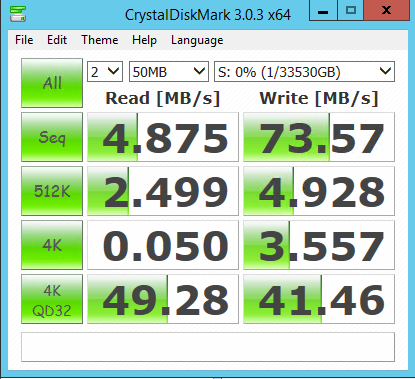
There are countless posts out there comparing E1000s and VMXNET3 and why the VMXNET3 should (where possible) always be used for Windows VMs. http://rickardnobel.se/vmxnet3-vs-e1000e-and-e1000-part-2/ http://longwhiteclouds.com/2014/08/01/vmware-vsphere-5-5-virtual-network-adapter-performance/ Last week I was provisioning a new Windows 2012 R2 VM to act as a Veeam Repository. For mass storage we have MD3200i’s presenting block storage over iSCSI. Going through the motions of a build that I’ve done countless times…I deployed the OS Template and then added to additional NICs to complete the VM build. After mounting the iSCSI Volume I went to do some basic benchmarking and throughput testing… Crystal Disk Mark is great for basic Performance Testing. The initial results where underwhelming to say the least. !(/images/2015/03/e1000_nic.png) Fairly poor read results …with OK sequential writes. The MD3200i Disk Groups are capable of doing 100-130MB/s so I knew something wasn’t right. I initially was looking at the physical network to blame…but everything checked out. I then looked at the iSCSI MPIO setup and again…everything checked out. Looking back though the VM hardware I found that I had mistakenly added E1000 NICs for the two additional iSCSI networks. After removing those and reconfiguring them as VMXNET3 I reran the tests and got the results I expected (though writes where low possibly due to concurrent operations) and all was well !(/images/2015/03/vmxnet3_nic.png)This was a quick public service announcement post to ensure VMXNET3 is used where possible. If you want to search through your environment for Windows VMs with E1000s…have a look at (http://anthonyspiteri.net/quick-cloudphysics-card-windows-server-2012-e1000-nics/ “Quick CloudPhysics Card: Windows Server 2012 and E1000 NICs”) using a CloudPhysics Card…and remember!
Please no more E1000s… #southpark #vmware (http://t.co/Kxgp0z0hXH) — Luke Brown (@Luke_br) March 27, 2015
4 Commentsarchived